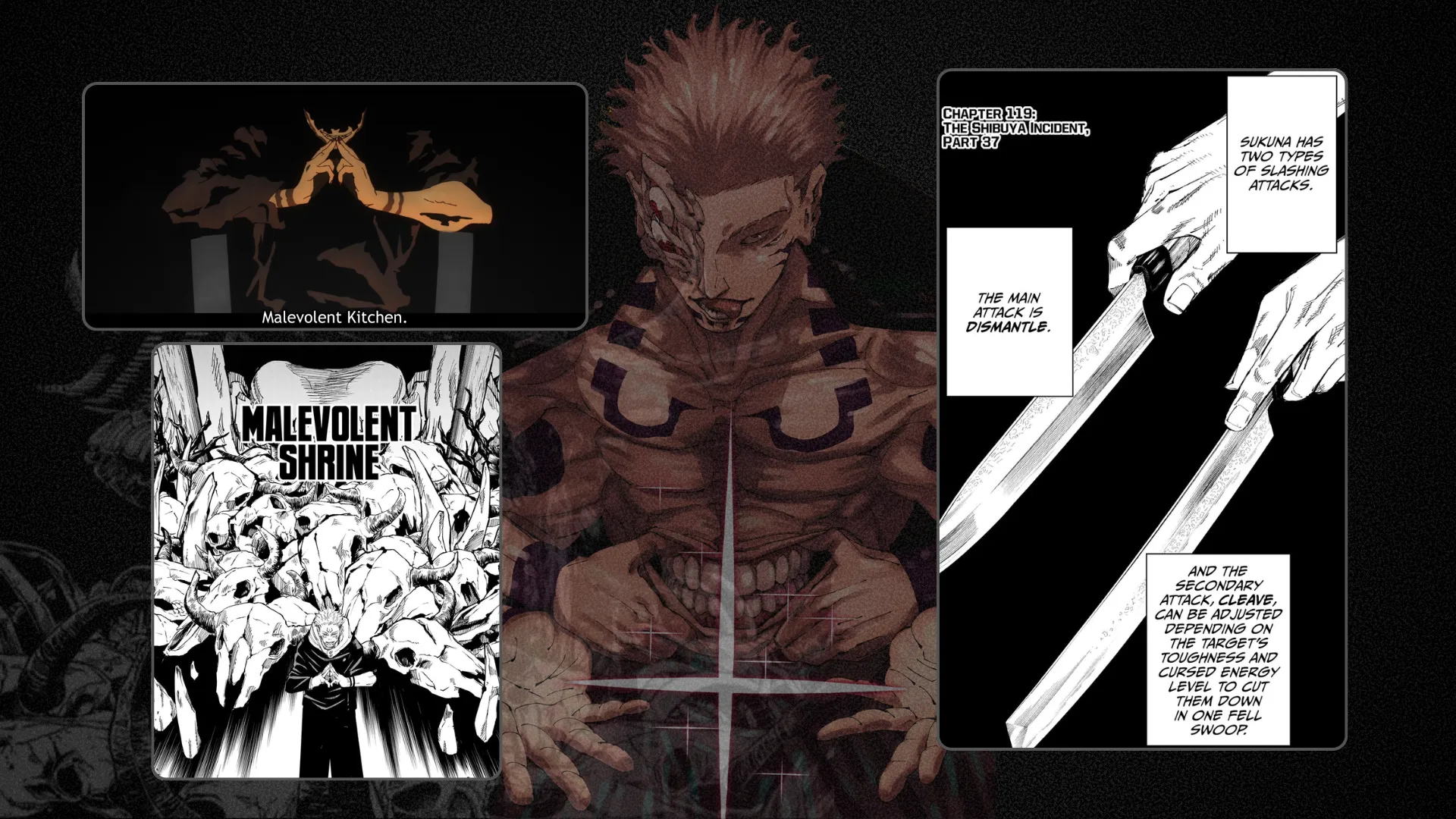
Just because you’re correct doesn’t mean you’re right. Let’s talk legacy translations.
In Jujutsu Kaisen, the villain’s domain expansion is called “伏魔御廚子” / “Fukuma Mizushi”, which was translated to “Malevolent Shrine”. Meanwhile, his innate technique, “Shrine” (御廚子 / Mizushi), includes two slashing moves: “捌 / 解” / “Hachi / Kai”, interpreted in English as “Cleave / Dismantle”.
Here’s the interesting part: “Mizushi” contains the traditional kanji for “kitchen”. “Hachi / Kai” also use kanji that can refer to “dismantling” and “filleting” meat.
Weird coincidence? Not quite.
In typical Japanese naming fashion, the deliberate wordplay was initially left up to interpretation. But considering that the character in question:
• Is a notorious cannibal. • Has a literal slice and dice technique. • Said technique was visualized as kitchen knives. • Constantly and consistently uses cooking euphemisms in battle. • Has a subordinate “Chef” whose technique makes them a human fridge.
In hindsight, the cooking motif was always the intended interpretation. But as they say, hindsight is 20/20.
JJK started as a Shonen Jump manga, meaning weekly serialization and weekly translation. The translator gets a chapter and a deadline and off they go.
While this format allows for simultaneous worldwide publishing, and has massively contributed to the popularity and success of manga as a whole, it’s also the nightmare scenario for the translators localizing these titles.
You’re potentially committing to a +200 chapter series while having little to no idea what the author is foreshadowing, with no way to directly ask them, and hardly any time to go back and analyze the smallest nuances.
Once you pick a term, you stick to it, no matter how things turn out. The cooking references didn’t make enough sense to be considered the intended interpretation at the start of the story, so the rule of cool won.
Crunchyroll’s Season 1 anime subs followed the official manga terminology, but in Season 2, they attempted to correct multiple terms (including “Mahoraga” to “Makora”)—the series’ fan base then promptly proceeded to clown on them until they reverted all the changes.
To this day, the vast majority of JJK fans are unaware that “Malevolent Kitchen” wasn’t a mistranslation. To them, it was just another cooked Crunchyroll sub.
Legacy translations aren’t always the best, or even correct. But they’re still the foundation fandom is built on. They’re sacred for a reason.
When you change legacy, remember that you’re also playing with your own.
By Seif Chaib.
Originally posted on Linkedin.