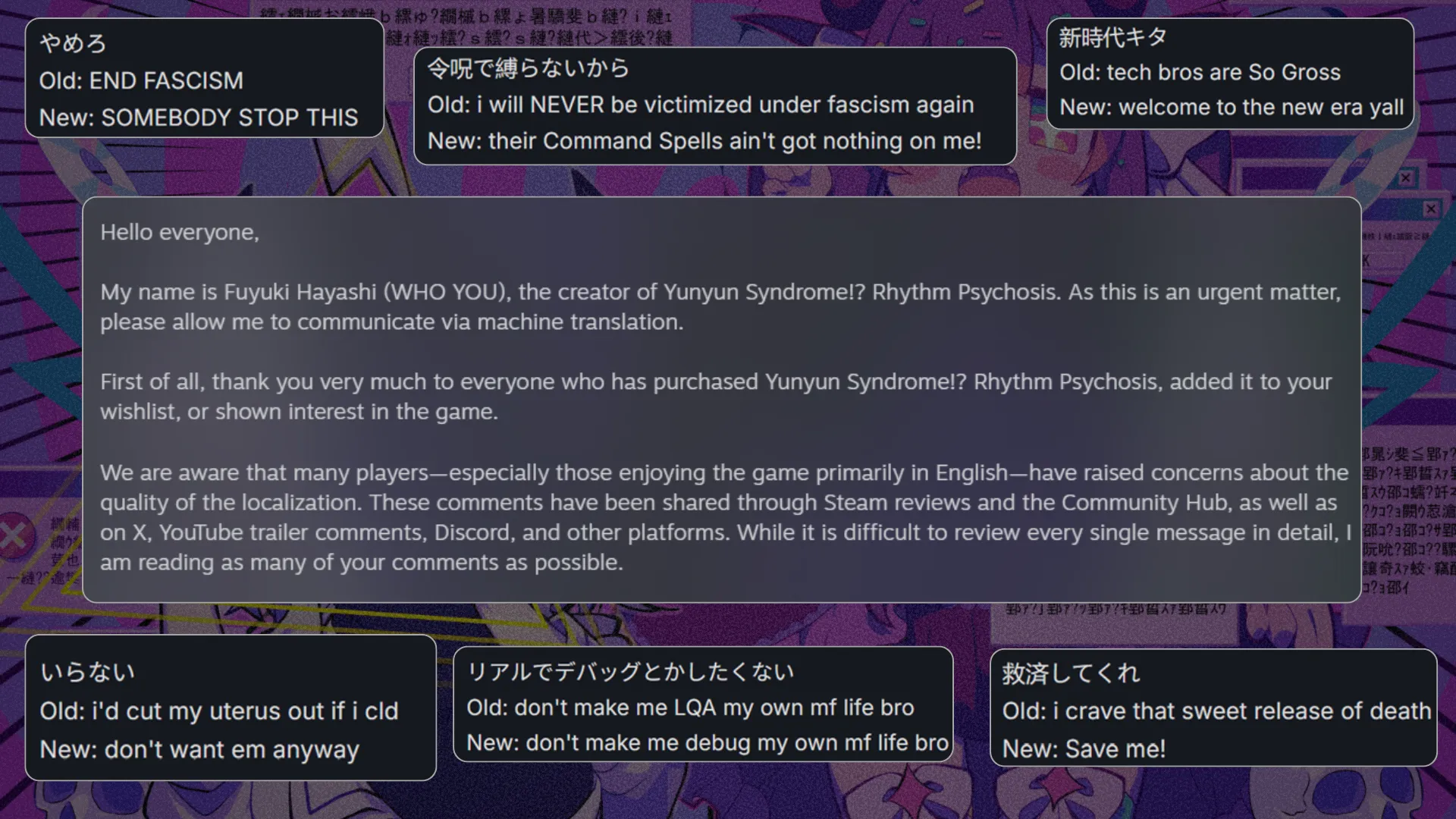
On the recent “hdyd, fellow kids” Yunyun Syndrome situation —
Due to how the Japanese-English side of the media localization industry deals with criticism, I think it’s moot to try to discuss what went wrong with any specific case of backlash.
Players, Media, and Chuds alike have already torn this loc to pieces anyhow—there’s not much ground left to tread.
So perhaps exploring why (normal, non “K**l All localizers!”) people tend to have such visceral reactions to locs like these is a better idea.
This is by no means the full picture, but it’s at least a part of it.
See, I got into the loc industry because, since I was around 10 and half-decent at English, I hated translations with a passion.
That might sound weird, but it’s what eventually made me want to try to do them better. I wouldn’t be typing this today if I didn’t hyper-focus on finding out exactly what pissed me off about bad translations back then.
Mostly, that hatred was fueled by real incompetence. Sometimes, perceived incompetence due to my limited language skills at the time.
I eventually grew out of that mentality, but one bit stayed with me: despising what I dubbed “competently horrible” work. Understanding why that is might be key to getting the Japanese to English loc discourse.
First, let’s define “competently horrible” localizations, because they don’t have the hallmarks you’d expect out of a bad translation. They’re often:
- Typo-free.
- Bug-free.
- More importantly, they read very naturally.
So far so good. So why the mean name, and why do they constantly and consistently end up being this divisive even among the non-weeb, non-terminally online demo?
It’s the horrendous choices.
Yes, regular horrendous translation choices usually don’t get such visceral reactions—especially since they’re usually a combo deal with the hallmark patterns of incompetence.
It’s when they aren’t that something feels deeply, deeply wrong. That’s when genuine hatred triggers.
The halo effect of perceived competence that comes with fluent prose, well LQA’d translations, and skillful adaptation signals something bad localizations proper don’t.
”We didn’t make the choices you hate because we don’t know what we’re doing, or because we didn’t have the time/budget, we made them because we wanted to.”
Depending on how large a hole the localizers dug for themselves, that can be read as stupidity, hubris, disrespect, or an outright act of disdain-fueled sabotage of the source material.
Despite the JP-EN side of the industry priding itself more than any other on clocking authorial intent and knowing what the end consumer wants more than they do, this basic string of thought is generally lost on that bubble.
Couple that with the rampant whataboutism and deflection of valid criticism -even if it comes from garbage humans-, and you start to understand why nobody learns from backlash, no matter how many times it happens.
TLDR: Making good loc is as easy as reading the room. Bye.
By Seif Chaib.
Originally posted on Linkedin.